Baroxon® | Leading Boom Barrier Manufacturer

How to Choose the Right Automatic Parking Barrier for Your Site in Kuwait
Release time:
2026-11-03
Introduction: the right choice starts with understanding the site
Choosing an automatic parking barrier is not only about the look of the boom or the price of the unit. A barrier that suits a villa driveway may be completely wrong for a busy shopping centre car park or a factory gate that trucks pass through all day. The decision should start with the nature of the site, the number of vehicles, the width of the lane, the operating hours and the way access is verified.
In Kuwait, the specification also has to account for high temperatures, dust, direct sunlight, and humidity with salt-laden air on coastal sites. Always check the actual operating conditions against the datasheet of the specific model, including its protection rating and permitted operating temperature.
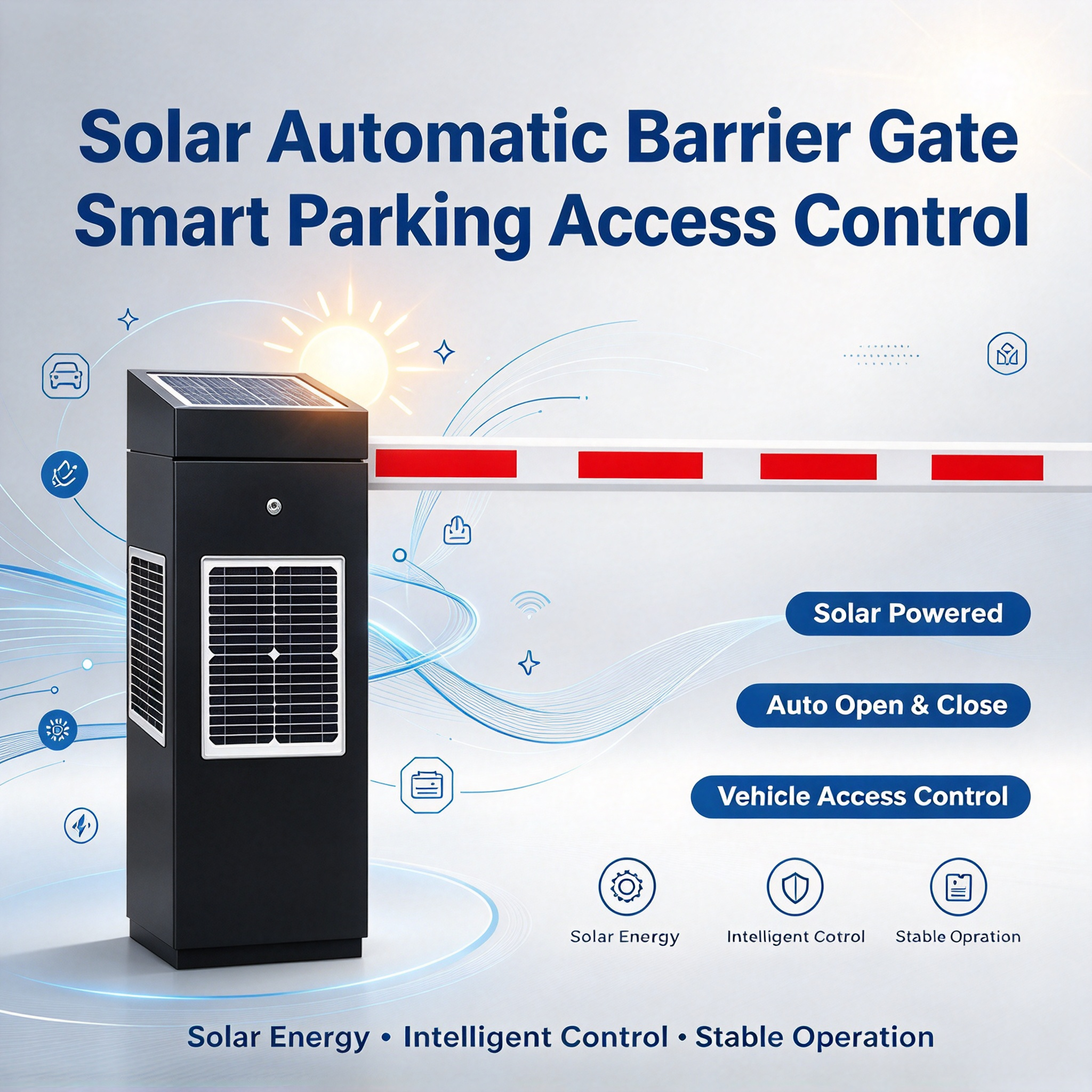
1. Define the site type and the traffic profile
Before comparing products, decide where the barrier will be installed and which vehicles will use the entrance. Residential, commercial and industrial entrances differ in operating frequency, security requirements and how visitors are handled.
Residential entrances and villas
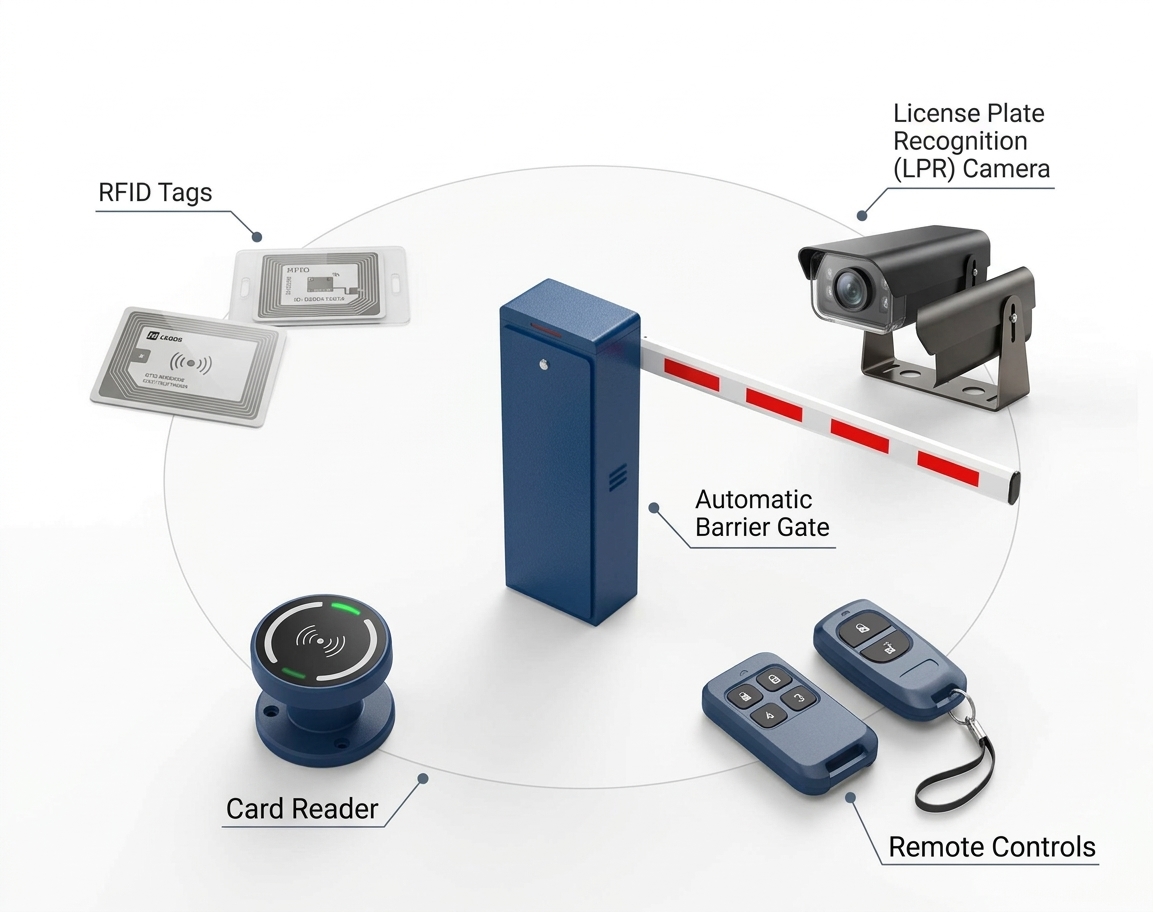
Villa and gated-community entrances usually need quiet, smooth operation for residents and a practical way to admit visitors. A barrier with a brushless DC motor can be combined with an ANPR/LPR camera holding a resident plate list, an RFID reader for authorised vehicles, or an intercom system for guest access.
Shopping centres and office buildings
In shopping centres and office towers, traffic density can change sharply between peak hours and the rest of the day. Assess vehicles per hour, the number of lanes, the ticketing or payment method, and whether staff and visitor movements must be logged. Depending on the parking management system, the barrier may be integrated with ANPR/LPR, parking tickets or QR codes.
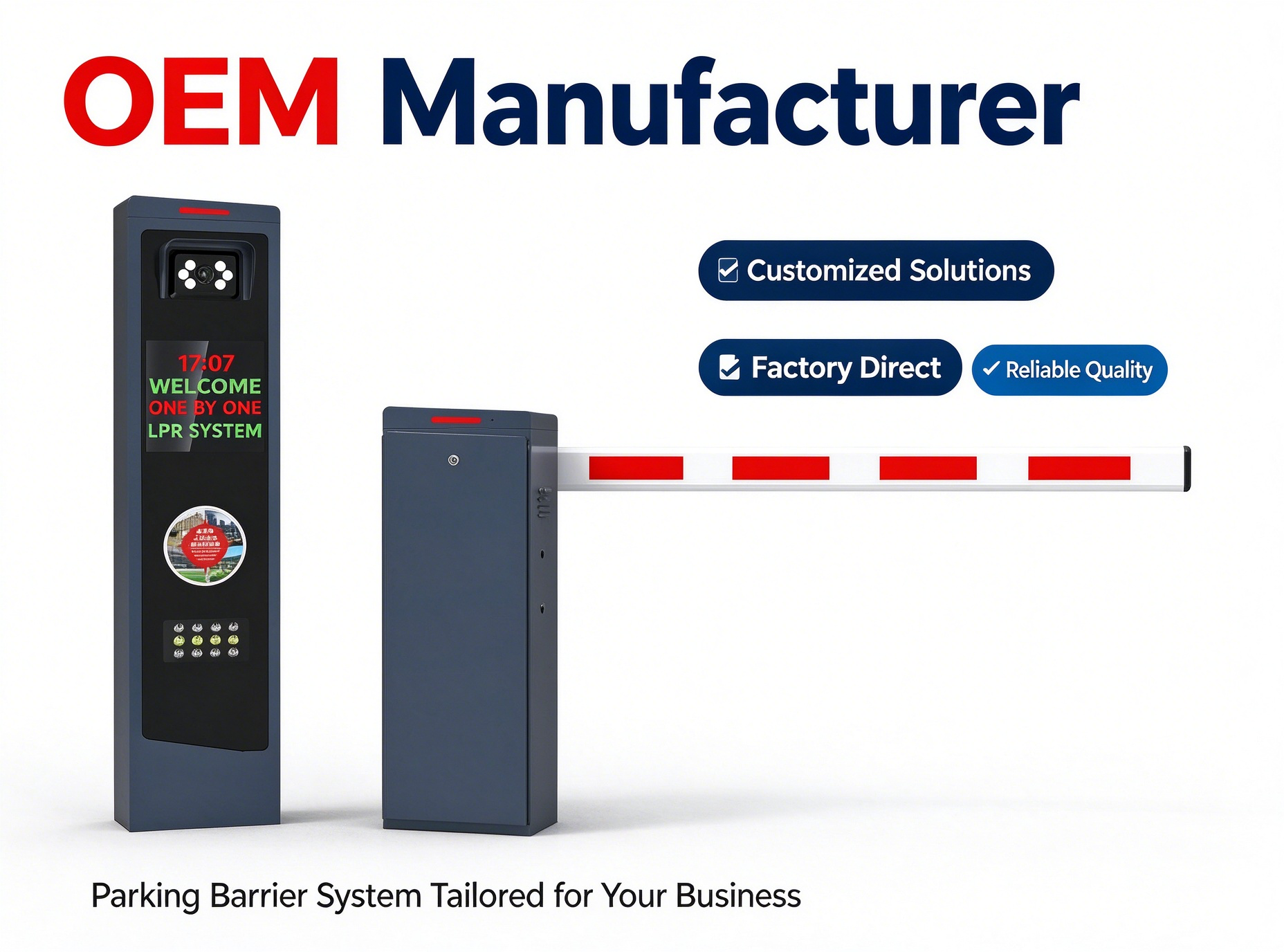
Factories and warehouses
Industrial and logistics sites need a closer assessment of truck and heavy-vehicle movement, lane width, operating hours and the number of open/close cycles per day. Heavy-duty industrial barriers, fence arms or long-range RFID solutions may suit some of these sites, but vehicle dimensions and safety requirements must be verified first.
2. Measure the lane width and choose the right boom length
Lane width is one of the first measurements to take. Measure the actual distance that must be closed, then confirm the position of the barrier cabinet, the direction of boom travel and the space available on both sides of the entrance. Do not choose the boom length from road width alone; the position of a column or traffic island, side obstacles and maintenance clearance all matter.
If the entrance is wide or used by trucks, an industrial configuration or more than one controlled lane may be required. BAROXON offers automatic boom barriers and solutions for commercial and industrial lanes. The maximum permitted boom length must always be confirmed for the specific barrier model, because boom length affects load, balance and motor requirements.
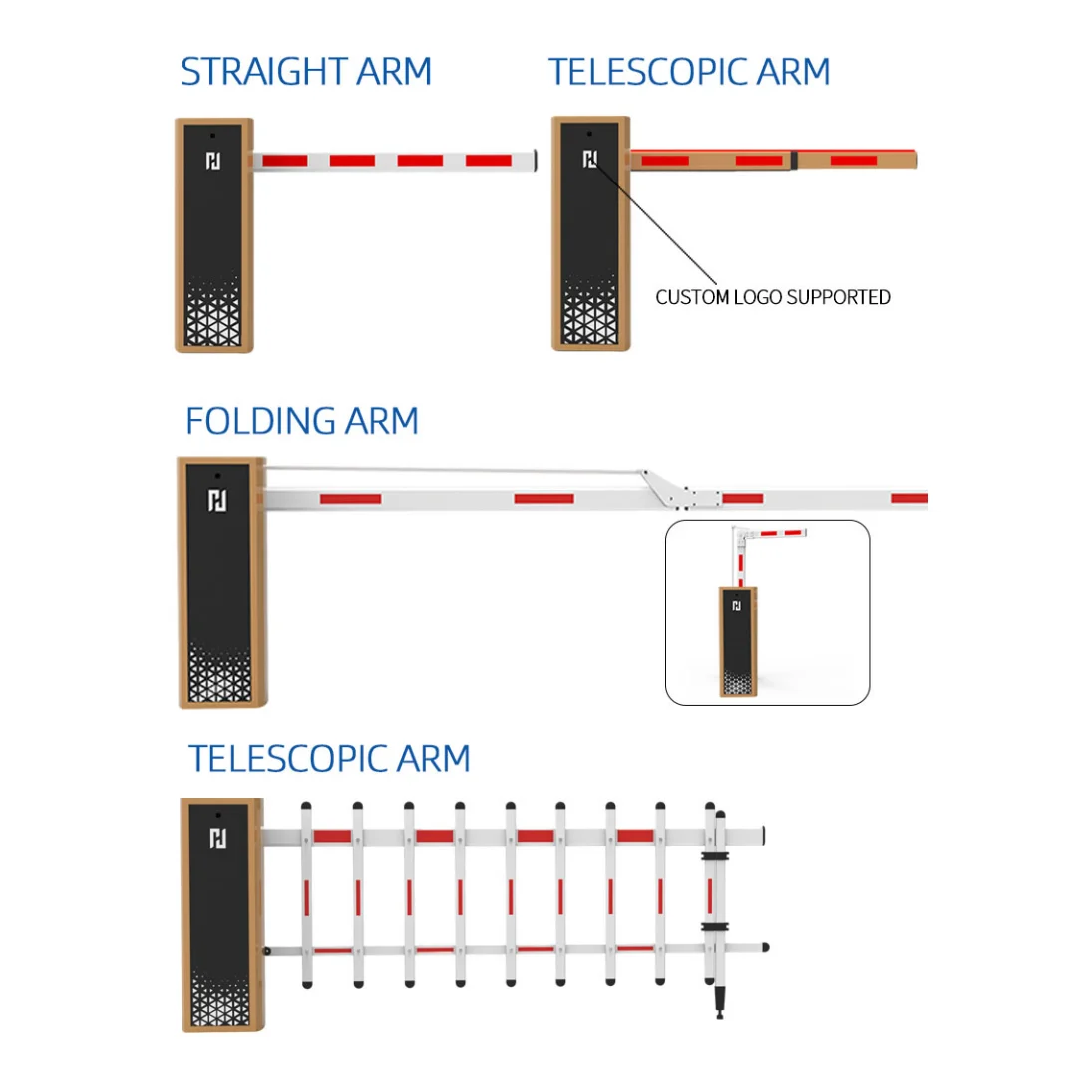
3. Select the boom type according to clearance and obstacles
A suitable boom length is not enough on its own. The boom must be able to open and close without striking a ceiling, a sign, cables or other fittings.
Straight arm
The straight arm is widely used on open car park entrances where vertical clearance is available. Depending on boom length and drive specifications, it can suit residential, commercial and industrial entrances.
Folding arm
A folding arm is considered when vertical space is limited, such as some covered car park entrances or basement levels. Ceiling height and the folding envelope must be measured precisely, and the movement must be checked against lighting, pipework and high-roof vehicles.
Fence arm
A fence arm can suit sites that need a clearly visible physical barrier or want to reduce the possibility of passing underneath the boom. Boom weight, wind exposure and the drive method should be assessed before selection, especially on outdoor entrances.
4. Assess traffic density and opening speed
Ask how many vehicles are expected per hour, how many open and close cycles occur each day, and whether the site runs without interruption. A barrier at a villa entrance rarely faces the same duty cycle as one at a shopping centre or a logistics facility.
Where traffic is heavy, compare standard barriers with high-speed barriers, and review opening and closing times, permitted duty cycle and operating temperature. Do not rely on the word "fast" alone; request the actual model data and confirm that the travel speed is compatible with vehicle stopping distance and safety requirements.
The BAROXON range includes a dedicated high-speed barrier category alongside boom barriers for commercial and industrial use. The final choice should still be based on site traffic and the product datasheet.
5. Choose the motor and drive mechanism
The motor type and transmission affect barrier speed, stability, noise level and maintenance requirements. BAROXON solutions include brushless DC motors and servo motors depending on product family and configuration, so operating data, voltage, duty cycle and warranty should be compared for the specific model.
For entrances close to residential units, low noise and smooth movement may be the priority. For frequently used industrial sites, continuous operation capability and the match between motor, actual boom length and load are usually more important.
6. Do not overlook safety devices and vehicle detection
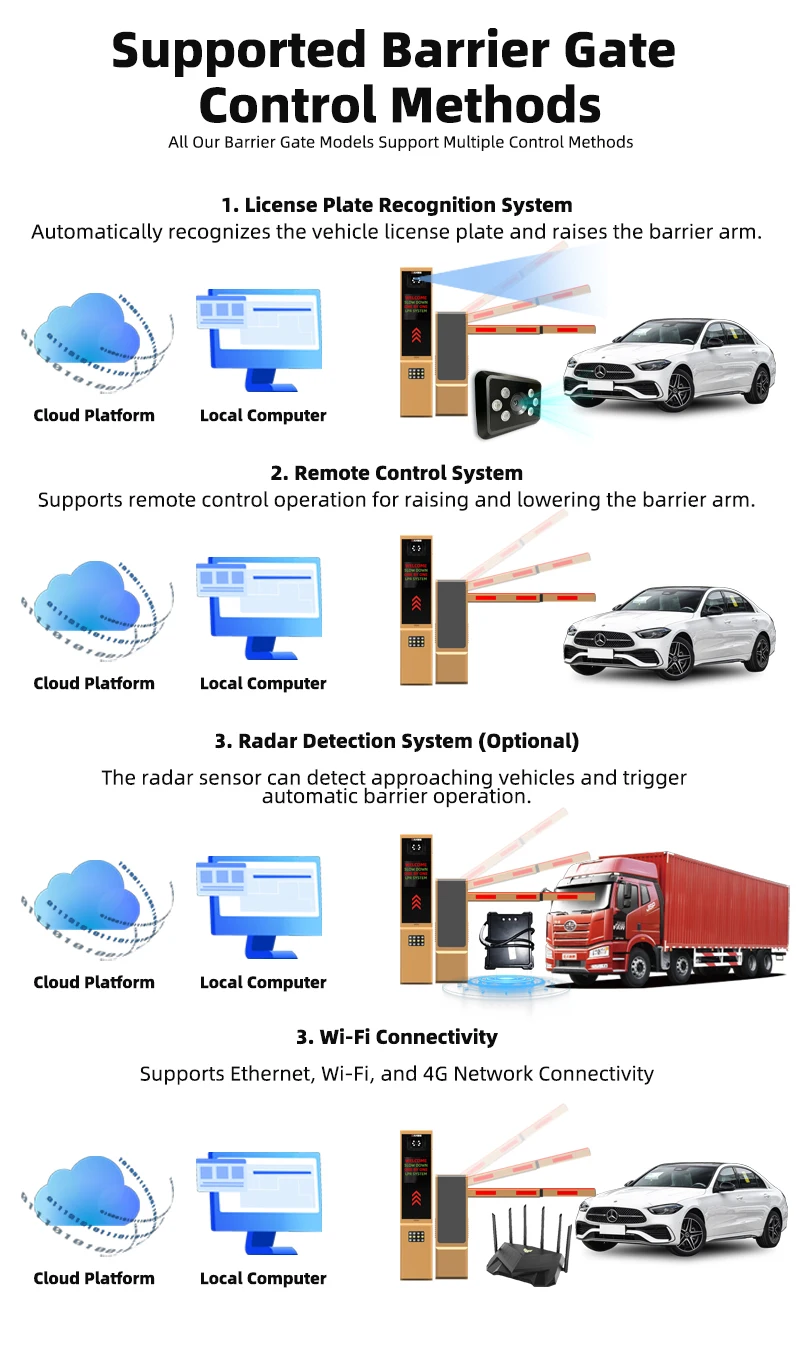
The barrier must work with suitable vehicle and obstacle detection, matched to the lane design and operating method. A radar sensor, induction loop or other detection device compatible with the controller can be used. Sensor position and detection zone must be set so that the boom never closes on a vehicle that is still in the crossing area.
BAROXON offers a 79 GHz vehicle detection radar sensor intended for boom barrier applications, and the product page explains its role in vehicle detection and anti-crash response. Before purchase, confirm compatibility with the control board, the wiring method, and on-site testing after installation.
Detection sensors are not a substitute for safe lane design or correct operating procedures. Manual operation during power failure, emergency stop or release devices where required, and training for site staff should also be defined.
7. Decide how access will be controlled: ANPR/LPR, RFID or tickets?
The vehicle verification method affects both user experience and the architecture of the parking system. Choose it according to the number of users, the type of visitors, the parking policy and the required level of automation.
Licence plate recognition (ANPR/LPR)
An ANPR/LPR camera captures the plate and reads the number, and the system compares the result with an authorised plate list or parking rules. A licence plate recognition system can suit residential communities, offices and car parks that want to reduce dependence on cards or paper tickets. Confirm that the system supports Kuwaiti plate formats, and check image quality, lighting, camera angle and vehicle speed at the reading point.
RFID control
RFID uses a card or electronic tag read by a compatible reader as the vehicle approaches. An automatic RFID barrier can suit pre-registered vehicles such as staff, residents and fleets. When selecting the system, compare actual read range, reader mounting position, card or tag type, and suitability for the vehicle passing speed.
Tickets, QR codes and payment
In commercial and visitor car parks, tickets, QR codes or self-service payment terminals may be part of the solution. Define whether the barrier will work with an existing system, how the ticket is validated, and how a lost ticket, incomplete payment or unrecorded exit is handled.
8. Account for Kuwait's heat, dust and outdoor conditions
An outdoor barrier in Kuwait can be exposed to high temperature, dust and intense sunlight, while coastal sites may need extra attention to materials, finishes and corrosion resistance. Ask the supplier for the operating temperature range, IP rating, cabinet material, coating suitability and the environmental limits of the control components.
BAROXON's Kuwait-market material references weather-resistant cabinet configurations and protection options such as IP65 on some products. Do not apply that rating to every model; request a certificate or datasheet for the exact product number you are buying, and verify the actual temperature, humidity and dust limits.
9. Calculate total cost, not just the barrier price
Project cost includes far more than the barrier unit. Allow for the boom, foundation, civil works, cabling, power supply, sensors, ANPR/LPR cameras or RFID readers, parking management software, installation, testing, training, spare parts and maintenance.
The cheapest option at purchase can become the most expensive over time if it does not match traffic density, needs repeated modification or has no spare parts supply. Ask for a detailed quotation showing the model, accessories, scope of supply, warranty, support services and exclusions.
10. Verify installation, integration and after-sales service
Before issuing a purchase order, request foundation and wiring drawings and a lane layout, and define who is responsible for civil and electrical work. The interface with the existing access control system, commissioning procedures, operator training, spare parts availability and technical support should also be clarified.
BAROXON's Kuwait-market information mentions installation guidance, commissioning support, training, spare parts and remote technical assistance. When requesting a quotation, ask which services are actually included and which party is responsible for support on your project site.
Preliminary recommendations by site type
| Site type | Configuration to consider | Key checks |
|---|---|---|
| Villa or residential compound | Quiet barrier with ANPR/LPR or RFID | Operating noise, visitor access, plate list |
| Shopping centre or office building | High-speed barrier with tickets or ANPR/LPR | Peak flow, number of lanes, payment and logging |
| Factory or warehouse | Heavy-duty industrial barrier with RFID or radar | Boom length, heavy vehicles, duty cycle |
| Low-clearance entrance | Folding arm barrier | Ceiling height, folding envelope, clearance |
| Exposed outdoor entrance | Dust and heat-ready configuration | IP rating, operating temperature, corrosion resistance |
These recommendations are a starting point only. The final decision should be based on site measurements and the datasheet of the selected model.
Checklist before choosing a parking barrier
- Confirm the site type and the vehicle mix.
- Measure the lane width and the space available for the barrier cabinet.
- Measure available height and decide between a straight or folding arm.
- Estimate vehicles per hour and daily operating cycles.
- Compare opening and closing times and the permitted duty cycle.
- Decide the control method: ANPR/LPR, RFID, tickets or QR.
- Check that vehicle and obstacle sensors are compatible with the controller.
- Review operating temperature, IP rating, dust and corrosion resistance.
- Request the model datasheet, foundation drawing and wiring diagram.
- Include installation, integration, maintenance and spare parts costs.
- Clarify warranty, training and technical support before purchase.
Why consider BAROXON solutions for your Kuwait project?
BAROXON's Kuwait-market product range covers boom barriers, high-speed barriers, ANPR/LPR licence plate recognition systems, RFID barriers, radar sensors and pedestrian access control. This allows a complete access control solution to be planned instead of buying a barrier in isolation from the entry management system.
Start by comparing product categories on the website, then send the supplier a clear site brief covering lane width, expected vehicle count, vehicle types, available height and the required control method. The more complete the information, the more accurate the technical recommendation, and the lower the risk of a model that does not match actual operating conditions.
Conclusion
Choosing the right automatic parking barrier starts with the site, not with the catalogue. Measure the lane, understand traffic density, and select the boom, motor, control method and safety devices according to actual use. In Kuwait, add a review of heat, dust and outdoor conditions, and always request the datasheet of the specific model before purchase.
Frequently asked questions
Which automatic parking barrier is best for villas in Kuwait?
It depends on the entrance width, the number of vehicles and how visitors are admitted. A quiet barrier with a brushless DC motor combined with ANPR/LPR or RFID can be considered, after confirming that the camera or reader is compatible with the access control system.
Should I choose a standard barrier or a high-speed barrier?
If vehicle numbers are limited, a standard barrier may be sufficient. For entrances with repeated movements or high traffic density, high-speed barriers should be compared, with duty cycle, actual operating time and safety requirements reviewed together.
Can a parking barrier be connected to a camera that reads Kuwaiti plates?
A compatible barrier can be integrated with an ANPR/LPR system, but the software must be confirmed to support Kuwaiti plate formats, together with the imaging conditions, camera angle, lighting and vehicle speed.
Is RFID suitable for factories and warehouses?
RFID can suit pre-registered vehicles and fleets, particularly where cards or tags need to be read as the vehicle approaches. Read range must be defined and performance tested under actual site conditions.
What protection rating do I need in Kuwait?
There is no single rating that suits every site. Review exposure to dust, rain, humidity, heat and cleaning water, then request the IP rating and operating temperature range for the specific model. Do not assume that IP65 applies to every product.
What information should I send to a supplier for an accurate recommendation?
Send the entrance layout, lane width, ceiling height, vehicle types, expected vehicles per hour, operating hours, required control method, site photos and the electrical drawing if available.
Planning a car park entrance in Kuwait?
Send your site details to the BAROXON team for a technical recommendation, or start with the contact page to discuss lane width, vehicle numbers and the control method you need before making a purchase decision.
Latest News
Baroxon® | Leading Boom Barrier Manufacturer
Advanced Security Access Control and Intelligent Parking Solutions.
Company Strength
Adequate Inventory
Fast Shipping
Our Products
CONTACT US
Address: No. 2 Wanshou Road, International Innovation Industrial Park, Jinan, Shandong, China







© COPYRIGHT 2025 Baroxon® | Leading Boom Barrier Manufacturer


Contact Us
Our passion is to bring your ideas to life. Work with our design team to create a one-of-a-kind custom finish or cladding system to create a truly unique space. Together we can make your story stand out. If you need something to request a sample, request pricing, or request a demo, please fill out the contact form below. Explain your request in as much detail as you can and a representative will contact you within 1 business day.